** WARNING: connection is not using a post-quantum key exchange algorithm.
** This session may be vulnerable to “store now, decrypt later” attacks.
** The server may need to be upgraded. See https://openssh.com/pq.html
** WARNING: connection is not using a post-quantum key exchange algorithm.
** This session may be vulnerable to “store now, decrypt later” attacks.
** The server may need to be upgraded. See https://openssh.com/pq.html
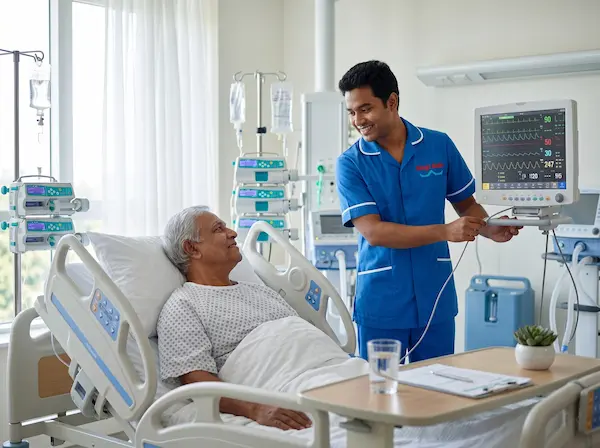
When a patient is critically ill, recovering from major surgery, or discharged from an ICU but still needs close medical supervision, a general caregiver isn’t enough — the situation calls for trained nursing-level attention. Kings Aide delivers expert intensive care service at home in Dhaka, so critical and post-surgery patients can continue recovering under close watch without staying in a hospital longer than medically necessary.
Our trained nurses and senior caregivers handle critical and post-surgery patients safely at home, monitoring vitals, managing equipment where required, and staying in coordination with the treating doctor throughout recovery. As Dhaka’s best nursing agency for home-based intensive care, we bridge the gap between hospital discharge and full recovery.
What’s Included in Our Intensive Care Service
Continuous vital monitoring. Blood pressure, oxygen levels, heart rate, and other critical indicators tracked on a strict schedule.
Medical equipment support. Assistance with oxygen support, feeding tubes, catheters, and other equipment as prescribed by the treating doctor.
Wound & post-surgical care. Dressing changes and monitoring for infection or complications after surgery.
Medication administration. Accurate, on-schedule administration of prescribed medication, including injections where required.
Mobility & positioning. Safe repositioning to prevent bedsores and complications from prolonged immobility.
Doctor coordination. Regular updates shared with the patient’s doctor, and immediate escalation if a patient’s condition changes.
24/7 nursing presence. Continuous or scheduled nursing coverage depending on the severity of the patient’s condition.
Who Needs Intensive Care at Home
Intensive care at home is appropriate for patients who no longer need to be in a hospital ICU, but still require a level of clinical monitoring beyond what a general caregiver or family member can safely provide. It’s not for every recovering patient — but for the right cases, it offers hospital-level attention in a private, familiar setting. Common situations include:
Patients discharged from an ICU who still need close monitoring
Post-surgical patients recovering from major operations
Patients on ventilator support, oxygen therapy, or tube feeding
Stroke or cardiac patients requiring close observation during recovery
Bedridden patients at risk of complications from prolonged immobility — see our dedicated bedridden patient care service
Hospital ICU vs. Intensive Care at Home
Not every critical patient needs to remain in a hospital ICU for the full length of their recovery. Once a doctor confirms a patient is stable enough to leave intensive hospital care but still needs close nursing supervision, home-based intensive care lets that supervision continue in a private, familiar setting — without the cost, infection risk, and bed pressure of an extended hospital stay. Our nurses coordinate directly with your patient’s doctor so care at home follows the same monitoring standards and escalates immediately if something changes.
Common Intensive Care Scenarios We Handle
“The hospital wants to discharge but we’re nervous about aftercare.” A nurse continues the same monitoring the patient received in hospital, so the transition home doesn’t mean a drop in care quality.
“My relative had major surgery and needs close watching.” Post-surgical monitoring, wound care, and medication management continue at home under trained supervision.
“We can’t afford to keep paying for an extended ICU stay.” Once a doctor confirms the patient is stable enough, home-based intensive care continues the same level of attention at a fraction of the ongoing hospital cost.
“My family member is on oxygen or tube feeding and we don’t know how to manage it.” Our nurses are trained specifically to manage this kind of equipment safely at home.
Choosing the Right Level of Care
Not every recovering patient needs full intensive-level nursing — and not every case that looks manageable actually is. During your consultation, we’ll ask about the patient’s discharge summary, current medications, mobility, and any equipment in use, and recommend the appropriate level of support: general home care for patients who are largely stable, or intensive care nursing for patients who still need close clinical monitoring. If needs change — in either direction — we adjust the care plan rather than locking your family into a fixed package.
Why Families Trust Kings Aide for Intensive Care
Trained, certified nurses — not general caregivers — handle critical and post-surgical patients.
24/7 availability for continuous or scheduled nursing coverage.
Direct doctor coordination so your patient’s care team stays informed.
Background-checked staff you can trust in your home during a vulnerable time.
A trusted local agency — over 2,645 patients and families served across Bangladesh.
How It Works
Free consultation. We discuss the patient’s condition, discharge summary, and medical requirements.
Assessment. We review equipment needs, monitoring frequency, and the home environment.
Nurse matching. We assign a nurse or senior caregiver experienced with the patient’s specific condition.
Ongoing monitoring. Regular updates to the family and the treating doctor as recovery progresses.
Nurse Training & Safety Standards
Intensive care at home only works if the nurse or senior caregiver placed with your family is genuinely qualified to handle a critical patient. Before joining our intensive care roster, Kings Aide staff are screened and trained on:
Clinical background verification — nursing credentials and identity checks before placement
Critical care fundamentals — vitals monitoring, safe positioning, and recognizing early warning signs of deterioration
Equipment handling — oxygen support, feeding tubes, catheters, and wound dressing as prescribed
Emergency escalation — knowing exactly when to contact the family and the treating doctor immediately rather than waiting
What to Expect in the First Few Days
When intensive care begins at home, the first few days focus on stabilizing a routine: confirming the medication and monitoring schedule set by the hospital, understanding any equipment the patient uses, and making sure the nurse and family are aligned on what “normal” looks like for this specific patient, so anything abnormal is caught quickly. We stay in close contact with the family during this period and adjust the care plan as the patient’s condition becomes clearer.
As the patient stabilizes, monitoring frequency and nursing hours are adjusted — sometimes stepping down from continuous coverage to scheduled visits as recovery progresses, always in line with guidance from the treating doctor.
Areas We Serve
Kings Aide is based in Baridhara and provides intensive care nursing to families across Dhaka, including Gulshan, Banani, Dhanmondi, and Uttara. Get in touch to confirm nurse availability in your specific area, especially for urgent post-hospital placements.
Pricing & Availability
Intensive care pricing depends on the level of nursing required, whether monitoring is continuous or scheduled, and any equipment support involved. Because every patient’s condition is different, we provide a specific quote after reviewing the case during a free consultation, rather than a generic rate.
As a general guide, continuous round-the-clock nursing costs more than scheduled visits a few times a day, and a patient requiring equipment management (oxygen, feeding tubes, catheters) typically needs a more experienced nurse than one who mainly needs monitoring and medication support. Share the patient’s discharge summary during your consultation so we can give an accurate quote rather than guessing at the level of care required.
Keeping Your Family Informed
When a loved one is critically ill, not knowing what’s happening is often as stressful as the illness itself. Our nurses provide regular updates to the family — vitals, medication given, any changes observed — so you’re never left wondering how the patient is doing between visits or check-ins. For families with relatives living abroad or outside Dhaka, we can arrange updates by phone so distance doesn’t mean being left out of a loved one’s care.
Medical Equipment at Home
Many families aren’t sure whether their home is even set up to support a recovering patient safely. During your consultation, we’ll talk through what equipment the patient currently uses in hospital — oxygen concentrators, feeding equipment, hospital beds, monitors — and advise on what’s needed at home. Our nurses are trained to work with this equipment safely, and we can advise on arranging rental or purchase where required, so the home is properly set up before the patient arrives.
Frequently Asked Questions
Can you provide 24-hour nursing care at home?
Yes. We arrange continuous or shift-based nursing coverage depending on how closely your patient needs to be monitored.
Can your nurses manage medical equipment like oxygen or feeding tubes?
Yes, our nurses are trained to support patients on oxygen therapy, feeding tubes, catheters, and similar equipment as prescribed by the treating doctor.
Will you coordinate with our hospital or doctor?
Yes. We stay in contact with the patient’s treating doctor, share monitoring updates, and escalate immediately if the patient’s condition changes.
Is intensive care at home safe for a critical patient?
Home-based intensive care is appropriate once a doctor confirms the patient is stable enough to leave hospital-level monitoring but still needs close nursing supervision. We follow the monitoring plan set by the treating doctor and escalate to hospital care immediately if the patient’s condition requires it.
Do you handle patients with dementia or memory conditions who also need intensive care?
Yes. Some patients need both clinical monitoring and the patience required to work with memory conditions. We match these cases with nurses experienced in both areas whenever possible, and coordinate closely with the family on routine and safety.
What’s the difference between intensive care and general home care?
General home care covers daily living support — personal care, mobility, meals, and companionship. Intensive care involves trained nursing staff managing clinical needs like vitals monitoring, medical equipment, wound care, and medication administration for critical or post-surgical patients.
Do you support patients discharged after surgery?
Yes — post-surgical recovery is one of the most common reasons families contact us. See our dedicated post-hospital recovery care page for more detail.
How quickly can a nurse be arranged?
For urgent cases, let us know during your consultation call — we prioritize critical and post-surgical placements and do our best to arrange nursing coverage quickly.
Will the same nurse stay with the patient throughout recovery?
We aim for continuity, since critical patients benefit from a nurse who already knows their baseline condition, medication schedule, and warning signs. Backup coverage is arranged in advance for shift changes, days off, or illness, so monitoring is never left uncovered.
What happens if the patient’s condition suddenly worsens?
Our nurses are trained to recognize warning signs early and escalate immediately — contacting the family and the treating doctor right away, and recommending a return to hospital care if the patient’s condition requires a level of support beyond what’s safe to manage at home.
Can intensive care step down to regular home care over time?
Yes. As a patient stabilizes, we can transition from intensive nursing care to general home care, adjusting the level of support as recovery progresses instead of keeping the family on a higher (and more expensive) tier of care than necessary.
How do I get started?
Book a free consultation below or call us directly with the patient’s condition and discharge details, and we’ll match a nurse or senior caregiver suited to the case.
Kings Aide has supported over 2,645 patients and families across Bangladesh, including many critical and post-surgical cases that required close nursing supervision at home. Intensive care is one of the more demanding services we provide, and it’s exactly why we only place trained, experienced nursing staff on these cases — a critical patient’s family shouldn’t have to worry about whether their caregiver is qualified for the job.